
Public speaking is more than simply being able to put words together. It is an art that requires not only clear thinking, but also a sense of inner freedom. People often focus all their attention on their fear instead of concentrating on structure and impact. But did you know that a clear speech structure can be one of the most powerful tools for managing anxiety? It creates a sense of security and redirects your energy away from fear and towards your goal.
We invite you to discover 5 essential steps that will help you prepare not just a good public speech, but a memorable one.
The best examples of rhetoric always have a strong foundation – a logical and coherent structure. It allows your audience to follow your train of thought while helping you feel in control of the situation.
Before you start writing, ask yourself: what is the one thing you want your audience to remember?
The first 30 seconds are crucial. You need to capture your audience’s attention and immediately establish an emotional connection.
Use what are known as hooks:
A shocking fact: “Did you know that 90% of people experience the same anxiety when speaking in public?”
A personal story: a short, authentic, and relevant situation connected to your topic.
A rhetorical question: a question that immediately makes the audience stop and think.
Human memory tends to retain information best when it is presented in three blocks. So divide your speech into three main sections, each supported by its own evidence, examples, or stories.
Part One: the problem (Why does this matter?)
Part Two: the solution (What can we do?)
Part Three: the vision and impact (How will this change our future?)
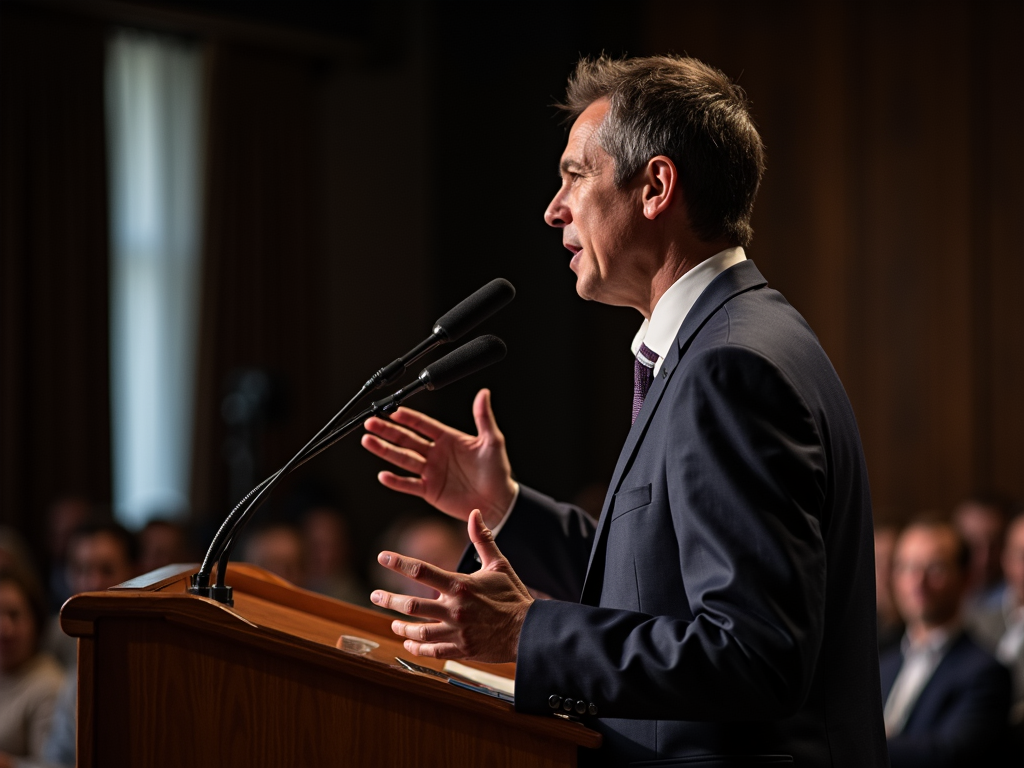
For your audience to truly hear you, a good structure alone is not enough. You also need authenticity and conscious control of your rhetoric.
Discover authenticity through the pause. One of the biggest mistakes speakers make is trying to fill every moment of silence. A pause is not empty space – it is a powerful tool for creating emotional tension and emphasising the importance of your words.
You can think of it as giving yourself and your audience space. Let your words “settle.”
Work with your body language – not just your hands. Your posture and facial expressions can speak louder than your voice. Learn to use the following consciously:
Eye contact: establish a brief, personal connection with 3–5 people in the audience during each paragraph.
“Anchoring”: use movement to divide the space. For example, talk about the problem while standing in one area of the stage, then move to another area when discussing the solution. This visually reinforces your message.
Never end your speech with a simple “thank you.” Your final sentence should be your strongest.
Summarise your core message (see Step 1).
Give your audience a call to action: what should they do immediately after your speech? (sign up, get started, read, reflect).
End with a slogan: a memorable, inspiring phrase that leaves an emotional impression.
Public speaking is not an obligation – it is a gift. With a clear structure (5 steps) and powerful rhetorical techniques (pauses, movement, body language), you can not only overcome your fear, but also allow your authenticity and professionalism to shine.
Let’s turn our fears into our strengths together!
Mes naudojame slapukus, siekdami optimizuoti svetainės funkcionalumą, analizuoti našumą ir suteikti jums asmeninės patirties. Kai kurie slapukai yra būtini, kad svetainė veiktų ir veiktų tinkamai. Šių slapukų negalima išjungti. Privatumo politika