
When I start talking about meditation in the corporate world, I often receive a polite but sceptical response. In many cases, it begins with the same question: “…so are we now going to have to sit cross-legged and chant ‘om’?”
I don’t know why, but this image seems to be one of the most persistent myths about meditation. But that’s not all. I also often hear concerns that these spiritual and religious practices could eventually turn an organisation into some kind of cult. And then comes the final argument: “…this has nothing to do with the business world or our everyday lives…”
Understandably, this perception can discourage businesses from adopting meditation practices for a long time. Yet more and more organisations are gradually turning to meditation as a way to gain a competitive advantage, improve performance, make better decisions, and support employee well-being.
For many people, meditation is still associated with a complex and unfamiliar mental practice. But meditation is not mystical. It is a simple, natural mental technique that requires no special effort.
During meditation, a person remains fully awake and aware while experiencing a unique state of calm, in which the body becomes deeply relaxed and the mind moves beyond its usual level of activity. This state is known as a transcendent state of consciousness, or pure consciousness. Subjectively, it is experienced as a profound sense of peace and fulfilment.
This state is a source of thoughts, creative potential, and energy. It also has a positive effect on the body’s self-regulation mechanisms and the recovery of the nervous system after experiencing stress and tension, which can contribute to a wide range of health problems. Meditation is an effective practical method for developing awareness, unlocking mental potential, and applying it in everyday life.
Meditation can also be described as:
a calm mind;
a mind focused on the present moment;
a mind free from doubts and expectations;
a mind that has returned to its source;
not an action, but the art of doing nothing—learning to simply be here and now;
training your attention: where we direct our attention and what we fill our awareness with is where our energy goes;
neither philosophy nor religion – it requires no special behaviour or lifestyle.
Thanks to various scientific studies supporting the benefits of meditation, the practice is gradually finding its place not only in our everyday lives, but also in the corporate world. Despite initial scepticism or distrust, more and more people are becoming interested in trying meditation in the workplace.
Around the world, an increasing number of companies are creating meditation rooms and encouraging employees to meditate during working hours. If you work intensively for eight or more hours a day and feel completely exhausted, what would be better: your tenth cup of coffee or the opportunity to calm your mind and genuinely rest?
Twenty minutes of meditation can leave you feeling as though your brain has been recharged and you are full of energy again.
So, below are 11 very practical benefits of meditation related to business and productivity. Companies such as American Express, Bank of America, Citicorp Finance, GE Capital, Hero Honda, Hewlett Packard, HSBC Bank plc., Motorola, Siemens, Tata Companies, and Sumitomo Heavy Industries have incorporated meditation into their workplaces and shared observations about the changes they experienced after beginning the practice.In all cases, increased achievement and improved financial results were reported. The added value created through meditation benefits not only organisations, but also the employees who practise it. According to research conducted by Stephanie Denning*, employees who meditate report significantly greater well-being, lower levels of stress when carrying out tasks, and greater creativity – all of which are important factors in successful business.
It is important to remember, however, that the benefits of meditation become noticeable over time. If you expect sensational results after the first or second session, you are likely to be disappointed—nothing changes that quickly. After all, when we start going to the gym, we cannot expect major changes immediately either.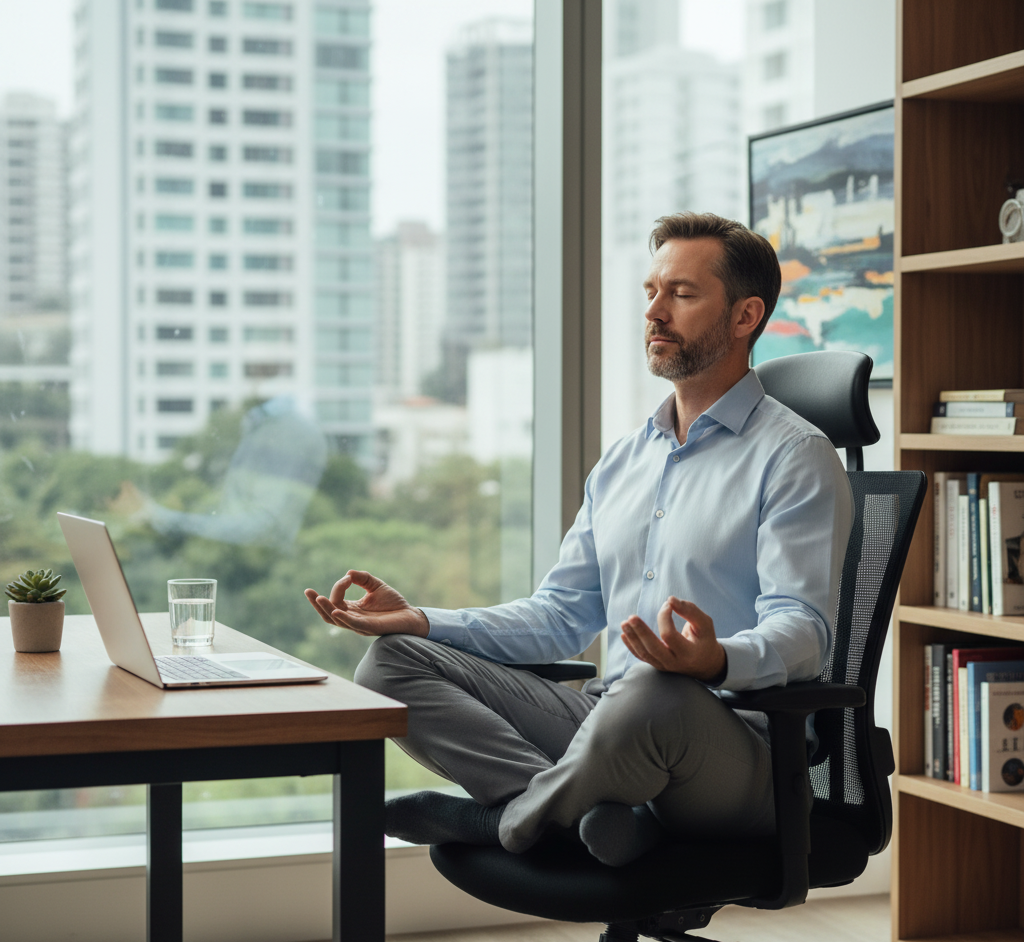
1. A healthier environment
Long-term stress can put the health of managers and employees at risk. Stress, exhaustion, and tension can contribute to psychological and even physical health problems. Meditation can help reduce the risk of difficulties and health issues that may affect employees and managers.
2. Less stress
One of the key benefits of meditation is its ability to help reduce stress. Everyday business routines can create anxiety and become a burden. Meditation can help people manage the chaos and frustration that arise from various disagreements and stressful situations.
3. Greater productivity
Meditation teaches us to pause and rest, refreshes our minds, and encourages new insights. As a result, employees can perform at their best.
4. Greater creativity
When employees are relaxed and less anxious, they can approach situations more creatively and come up with more original ways to complete their tasks.
5. Higher emotional intelligence
Encouraging employees to meditate can support their emotional intelligence. An employee overwhelmed by anger or anxiety may say something they later regret. Through meditation, employees can develop greater awareness of their own emotions and improve the way they relate to their colleagues.
6. Better focus
Various meditation exercises can help people maintain their attention on a single object for longer periods of time. As a result, employees can focus more effectively on their work and maintain their attention during business meetings. A direct result of this practice can be increased productivity.
7. Better decision-making
Greater concentration and the ability to relax can contribute to better decisions, which in turn can improve organisational performance. Meditation reportedly helped Steve Jobs make decisions and maintain a long-term perspective. Today, we can all see the results of his work.
8. Less emotional detachment
Meditation can strengthen our connection with the world around us. It can reduce emotional detachment and foster stronger emotional connections with colleagues and clients.
9. Stronger intuition
Meditation can help people become more aware of their natural intuitive abilities and pay closer attention to their inner voice. Meditation can help develop intuition.
10. More empathetic decisions
Meditation can strengthen our sense of empathy. Imagine empathy deeply rooted in your company culture. An empathetic person considers the consequences of their actions for others and may be more inclined to make decisions that benefit everyone involved.
11. It costs nothing
Compared with personal development training, gym memberships, or other relaxation methods that require financial resources, meditation costs nothing. All you need is the willingness to practise and a little time. It is a simple, natural mental practice that requires no special effort.
The least meditation can offer us is rest and complete relaxation – something most of us probably need more of.
The main benefits of meditation are a sense of well-being, inner peace, and powerful creative energy that each practitioner can discover within themselves.With this article, I invite everyone to be curious. I hope to spark your interest in trying meditation and experiencing its benefits for yourself. And getting started is not as difficult as it may seem.
You can begin with one of the simplest and, at the same time, most powerful meditation practices: breathing techniques. All you need is a quiet place where you can spend a few uninterrupted minutes with yourself. Sit down, close your eyes (this can help you relax more quickly), and begin your meditation.
This practice consists of two parts:
Balancing the breath. This is an introduction to meditation – a transition from the external to the internal space. To balance your breathing, make the duration of your inhalation and exhalation equal. For example, inhale for 4 seconds and exhale for 4 seconds (you can use 2, 3, 5, or more seconds – the important thing is that you feel comfortable; do not force yourself). Repeat several times until you feel a pleasant wave of calm and relaxation spreading through your body.
Observing the breath. Throughout the meditation, focus your attention on your breathing – how you inhale and exhale, how the air enters and leaves your body. Keep your attention on the breath. It does not matter how you breathe (into your belly or chest, quickly or slowly, deeply or shallowly); what matters is observing your breathing. Of course, intrusive thoughts will soon begin to appear: “What am I doing here? Have I taken care of everything? Have I messaged everyone?” That is perfectly fine. Your mind is simply doing its job. Do not cling to the thoughts – they came, and they will go. Intrusive thoughts are simply a reminder to bring your full attention back to your breathing. How long should you meditate? Ideally, twice a day for 20 minutes. But if you only have 10, 5, or 3 minutes – or even just a moment for a few conscious breaths – that is still worthwhile, especially when you are just beginning your meditation practice.
I wish patience to everyone preparing to begin meditating. It is important not to have preconceived expectations or wait for a particular result, because the practice of meditation itself is already the result.
And when we stop expecting a specific outcome, when we simply remain here and now, when we simply enjoy the present moment, that is when… THAT happens! And soon, the results appear as well.
I have personally been practising Transcendental Meditation for more than 10 years. Intensive conscious breathing practices are also important to me. And, of course, all of this fits perfectly alongside an active business life.
When we still so often hear people say, “It’s either business or meditation,” I can only repeat that this is a myth that it is time to completely break down.
Meditation and business are not only compatible—they can complement each other extremely well. The result of this combination is relaxation, better well-being, and creative energy that can bring new ideas and valuable discoveries into the world.
Finally, allow me to freely paraphrase the Buddha: you do not have to believe a single word I say. Just try it once.
* “The Benefits Of Meditation In Business”, Stephanie Denning, Forbes, February 2018.
Mes naudojame slapukus, siekdami optimizuoti svetainės funkcionalumą, analizuoti našumą ir suteikti jums asmeninės patirties. Kai kurie slapukai yra būtini, kad svetainė veiktų ir veiktų tinkamai. Šių slapukų negalima išjungti. Privatumo politika